
Startseite Endocrine disruptors and their impact on hormone balance, fertility and healthy ageing
Endocrine disruptors and their impact on hormone balance, fertility and healthy ageing
Dear Patients,
Endocrine disruptors are substances found in our environment that affect our hormones. They are also known as exogenous hormones, xenohormones or environmental hormones. These substances can mimic, enhance or block the effects of the body’s own hormones, thereby disrupting hormonal balance. They are found in plastics, cosmetics, pesticides, household chemicals and other everyday products, amongst other things.
At the Alpstein Clinic, we therefore do not view hormonal disorders in isolation. Particularly in the case of symptoms relating to fertility, the menopause, vitality or hormone-dependent conditions, it can be useful to include environmental factors and their potential effects on the body in the diagnostic process.
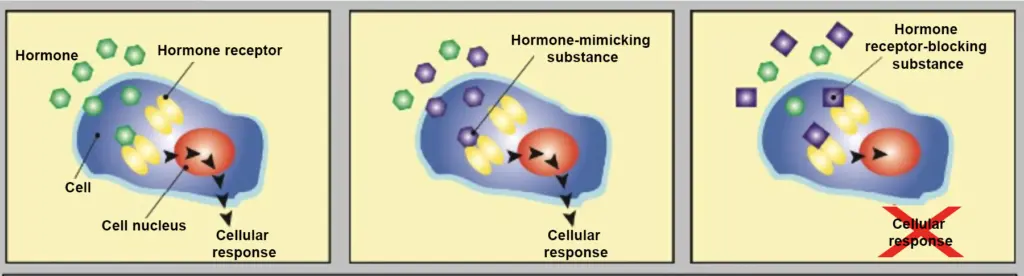
The body’s own hormones enter a target cell (left), bind to hormone receptors, and trigger the desired cellular response. Endocrine disruptors can mimic hormones and activate a cellular response like a natural hormone (center), or act as inhibitors by blocking the binding site of the natural hormone (right). In the latter case, the cellular response does not occur.



What are endocrine disruptors?
What are endocrine disruptors?
Substances that act like hormones but are not hormones are known as endocrine disruptors. They can interfere with hormonal regulatory systems and disrupt them. This can lead to dysregulation, for example when natural hormones are blocked or their effects are altered.
As hormonal processes in the body are finely tuned, even minor disruptions can affect various bodily functions. These include the menstrual cycle, fertility, sleep, mood, energy levels and general well-being.
Possible effects on hormone balance and fertility
These xenohormones may, amongst other things, play a significant role in relation to fertility and sex hormones. They are suspected of affecting the hormonal balance in both women and men, thereby contributing to various health issues. These may include menstrual irregularities, menopausal symptoms, declining vitality, loss of libido, impotence, as well as mood swings and sleep disorders.
However, as these symptoms can have very different causes, a thorough medical assessment is particularly important. It is crucial not only to consider hormone levels in isolation, but also to take potential contributing factors into account during the diagnostic process.
Premature ageing and hormone-related conditions
Hormonal imbalances can affect not only how you feel at any given moment, but also influence the ageing process. In this context, the focus is on typical age-related changes in the blood vessels, bones, skin and nervous system. These include, for example, atherosclerosis, osteoporosis, changes in skin structure and cognitive impairment.
The issue of hormone-active environmental pollutants may also be relevant in the case of hormone-dependent diseases. These include, for example, breast and ovarian cancer or prostate cancer, but also benign, hormone-dependent changes such as fibroids or ovarian cysts.

Holistic diagnosis of hormonal disorders
When treating hormonal complaints, the Alpstein Clinic initially focuses on a comprehensive, holistic diagnostic approach. This includes laboratory tests as well as an assessment of the internal environment and any potential regulatory imbalances. A standard hormone analysis of blood or saliva can provide initial indications of hormonal imbalances and, in some cases, may also raise suspicions of exposure to endocrine disruptors.
Further analyses may be useful as a supplement. Depending on the specific issue, these may include hair analyses or more precise blood tests. The aim is not merely to suspect potential exposure, but to classify it as clearly as possible through diagnostic means.
How stress can be reduced
If there are indications of exposure, the Alpstein Clinic adopts a multi-stage approach. The primary focus is initially on reducing exposure. This means avoiding or minimising exposure to endocrine-disrupting substances in everyday life wherever possible, for example in food, cosmetics, household chemicals or bath products.
In addition, measures to support elimination and detoxification may be beneficial. Depending on the individual situation, these may include herbal or homeopathic complexes to support the liver, kidneys and lymphatic system, a medical colon cleanse, fasting and drinking cures, toxin binders or targeted infusions.
Another aspect is the elimination of chronic sites of inflammation. These may include chronic dental or sinus conditions, inflammation in the urogenital area, or an unhealthy gut environment. In this context, collaboration with holistic-biological dentistry can also play an important role.
INUSpheresis® as a further approach
At the Alpstein Clinic, INUSpheresis® can also form part of a comprehensive treatment plan. This procedure is used to reduce environmental toxins and thus incorporate the impact of endocrine disruptors into a holistic therapeutic approach. The appropriate steps to take always depend on the individual’s initial condition, their symptoms and the results of the diagnostic tests.
When hormones are replaced, it should be done on an individual basis
If a hormone deficiency has been confirmed and potential contributing factors have been carefully considered, hormone replacement therapy may be appropriate in individual cases. The focus here is on personalised, laboratory-supported care. It is crucial that such treatment is not provided in isolation, but is integrated into a more comprehensive medical plan.
Our approach at the Alpstein Clinic
At the Alpstein Clinic, we consider hormonal complaints, fertility issues and age-related changes in the context of the whole body. Endocrine disruptors are one possible contributing factor among many.
In our view, careful diagnosis is crucial for planning individualised and medically appropriate treatment steps. Our aim is to identify stressors, support regulatory processes and relieve the body where this is appropriate and indicated in each specific case.

Dr. med. Ralf Oettmeier

We look forward to meeting you in person
If you are experiencing hormonal symptoms or would like to find out more about the potential role of endocrine disruptors, we would be happy to offer you a personal consultation at the Alpstein Clinic.


